Monthly Archives: December 2023

Don’t believe what you think: Thinking Differently

The holidays allows time to think. In most cases our thinking is in confirmation of our beliefs. One of the best bumper stickers I have seen stated: “Don’t Believe What You Think”. I is clear to me that this statement is warning us about our biasses and misconceptions, which we have many!

With his book “Think Again” Adam Grant helps us to understand our biasses and misconceptions, and how we can remediate the situation.
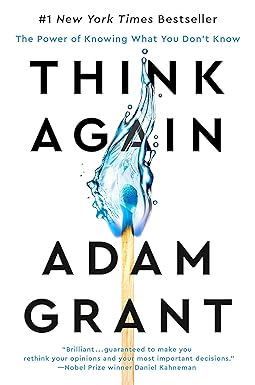
Grant even goes as far as share about life of death situations, where firefighters lost or saved their life based on thinking differently. This is a complicated subject because we start with a framework of thinking, our mindset, that has been structured for many years and based on people and circumstances that are familiar. Thus, very difficult to analyze. The difficulty of thinking differently comes from evolutionary psychology, where we have use the stubbornness of our ideas as a way to survive. But it has also been counterproductive. Think about companies that have not survived. Examples. like the BlackBerry, Kodak abound which leaders were unwilling to change because they were sure they knew all about the company and unable to see that the reality of the environment had changed. After all these leaders were the ones that lifted these companies to the high level of success they attained. Yes, but that happened under past circumstances, now things were different. These companies failed because they weren’t able to innovate and adapt.

These last days of 2023 are for me, days to reflect and find my blindspots. Where am I thinking wrong? Which ideas, deep in my ego, are wrong, and need to be replaced?

It is hard work to be done by yourself alone. There are techniques that help you see your ideas through a critical lens. Get help from those you trust. Quakers have what is called “clearness committees” https://www.fgcquaker.org/fgcresources/practical/practices/clearness-committees/ which is a tool used by Quakers to find, as the name implies, clearness in their thoughts. The main reason you, probably, need outside help is that your mind is already set. Your ideas are already yours! This is where someone else can ask you something like “have you thought of ……?” Which, of course, you might have not thought of. Now you have a new idea! If this new idea is better than the one you had before then you go ahead and replace it, innovate, adapt.

Successful leaders have learned this. Steve Jobs, for example, was opposed to the idea of the iPhone! Until he was for it. Convinced by people who had his trust and were able to speak freely, people who weren’t “yes sir” employees. This is what successful leaders do!

These last days of the year are overwhelming to our inbox, all fundraisers are busy sending emails telling us that the time is running out before we get extra impact on our donations. I have been busy deleting all these emails. So, I am not too optimistic about you having time to read it but I hope that one day you will. Meanwhile my thoughts are about wishing you all a great new year, I hope that 2024 will bring you good health, peace and prosperity.

The Subtle Art of Not Giving a F*ck

The best book I read this year was “The Subtle Art of Not Giving a Fu*ck” by Mark Manson. It was my favorite summer book. Later I saw a documentary with the same name featuring Mr. Manson, which is also highly recommended. It is in a way a book based on Stoic philosophy, without trying to be snobbish or academic.

Later I learned that the book has been quite popular even in a viral picture of esteemed US Congresswoman Ms. Katie Porter (D-California)

For years I have been a student of philosophy, first interested in Natural Philosophy for which I got a Ph. D. in 1982 at the Unversity of Newcastle U/Tyne, England. Those studies helped me be a scientist and work for the National Institute of Petroleum in Mexico where I ran a lab doing isotopic analysis for Geochronology. Measuring the age of rocks using the K/Ar method! In later years I have added metaphysical philosophy to include Stoicism to help me live a better life. Contrary to common belief, Stoicism is about the proper use of our emotions not as many think the elimination of our emotions, and control of our natural instincts that after human evolution have been a source of conflict in our lives.

One of the tenets of Stoic philosophy is “Memento Mori” (Remember Death) which is a reminder of our limited time on this Earth. For many thinking about death is depressing, but for me is uplifting because helps me have a broad perspective about life and things in general. One day I am going to be dead, then it will not matter. Others, my descendants, in particular, will continue with their lives having the same aspirations and struggles as the generations before. Sure, some things like technology have changed but the aspirations and the purposes have not. Human Nature is what has been since the beginning and will be until the end!

As it is in your own story, there are many stories and tales in my own that help me reflect on how many obstacles are there in each of our lives that are circumstantial and unavoidable but will always have a lesson that will improve who we are. Hopefully.

Let me write about one example. My grandfather’s grandfather, Geb Benson was shot to death in 1874 by a “neighbor” John Tuttle when my Great-great-grandfather was only 34 years old! His wife, my Great-great-grandmother, Irene was pregnant with her youngest child and had to go “back” to Iowa taking with her their other children, including my Great-grandmother Irene. Can you imagine the tragedy? How does a young mother have to endure such hardship and make ends meet to continue living and supporting her family? You may say: this is 2023 and it doesn’t matter what happened in 1874 but somehow, I tell myself, it does matter!

Memento Mori is a powerful tool to see and evaluate circumstances and provide the energy necessary to continue having a good life. One with inspiration and gratitude. After all the pursuit of happiness is the most important purpose in one’s life.

If you pay peanuts, you get monkeys

Once upon a time, I met Dr. Diandra Leslie-Pelecky author of the book “The Physics of NASCAR” during a meeting of the Pacific Northwest Association for College Physics.

She is a physicist who studies how physics is used to achieve excellence and did some research on the National Association of Stock Car Racing, an enterprise that manages one of the most successful businesses in the USA. In car racing, as in any race, the only goal is to be the first one at the finish line. This very simple objective gets complicated when you see how many elements are part of the race. In an automobile, there are literally thousands of parts and there is “the human element”. The physics applies to the mechanical elements but psychology applies to the human element, and you need both to win.

In her book, Dr. Leslie-Pelecky clearly articulates the physical implications, such as air pressure in tires, friction in bearings, and other interesting physical and chemical principles. Design and planning engineering are critical for the functioning of the operation. There is a lot of knowledge used before the race to prepare the automobile to function at the highest performance. All aspects of the mechanical function of the automobile are interdependent, but interdependence complicates every human endeavor. This complication must be resolved using “design thinking”. Design thinking fundamentally is the knowledge and use of human behavior in the accomplishment of a mission. In car racing, the mission is to win! And a remarkable achievement has been made. Imagine how in Formula 1 racing a pit stop where all four tires are changed can last only 2 to 3 SECONDS! Just let us pause now and count up to 3 seconds and imagine how the four tires are been replaced.

How can this high level of accomplishment be done? The answer is in the human element! People at NASCAR are highly prepared (high rate of Ph. Ds ) and very well compensated. As Dr. Leslie-Pelecky told me the saying there at NASCAR is: “If you pay peanuts, you get monkeys”

When the Future Arrives

It has been a paradox in human history. Preparing for a future that never arrives. I heard once a Brazilian say that Brazilians are tired of being the country of the future. Maybe because they have been the country of the future for generations. While at the same time, the present is full of misery, poverty, insecurity, and crime. This promise of a better future has been the most efficient tool of oppressive regimes to help subordinate and control populations.

Now, I feel, the time has come when we can say that the future is here. Not because of new technologies, or gadgets in the market but because of the emergence of a new paradigm. There is nothing wrong with preparation and work on the foundations of things. Being organizations or actual buildings, one has to be clear as much as possible of the objectives but there is always a need for preparation for the unexpected. There is always a need for preparation and adaptation to uncertainty and changing circumstances. Adaptation is the name of success!

Now, how does one prepare for the unexpected? How can one incorporate in a plan the steps to take in case of an unexpected event? What kind of steps are supposed to be taken in case of an unexpected event?

It sure seems like an unanswerable situation! But no, there is a way to prepare for the unexpected. Solid foundations are required in a building to sustain unexpected environmental events even when they are not expected. There is a limit, of course, to the extent to which one invests in building foundations. There is the cost involved. For example, for buildings outside of seismic zones, it would be extremely costly to build something that would resist a highly unexpected scale 8 earthquake.

In the case of organizations preparing for the unexpected, human capital is what needs to be prepared. And it is not about quantity but quality. As the future is now here, those in the organization need to be updated about the current trends in each category. Not only able to use the most recent technologies but also able to understand the fluidity of technical innovation in their field. The good news is that we have all the means to achieve it. AI among other things!

The Crisis of Trust

Rarely we see good news. It looks like news organizations, big and small, have found that only bad news sells. If you want to make money in the news business you need to convey bad, horrible news. The worst the better. So no wonder that today people, after years of this model, feel overwhelm and think that they can trust nobody.

Business, capitalism in particular was build on trust. People would make transactions based on a hand-shake or a simple document. I have seen (was back when I lived in Mexico) the transfer of a property written on the back of a wall calendar! Those were the days when polls had 60% or more of people trusting other people. I remember when in the times of videocassettes, Blockbusters will rent videos trusting customers to return them without the need to check the return, you would just slide it through an opening into some box. My library, as many others, allows you to return your books in the same way. This is because there is a basic understanding that we are borrowing/renting in good faith.

Funny how we use the word “faith” when talking about trust. Good faith is the basis of trust. But over the years we have been educated in doing things assuming that the other person in not acting in good faith. So business contracts include clauses that guarantee the transaction regardless of the good faith of those participating in the contract.

Looking at the dictionary the word faith is related to trust and confidence. Faith is complete trust and confidence in someone or something (Google/Oxford). For example: this restores faith in politicians. Also, faith is defined in relationship to a deity. For example: Faith is a strong believe in God or in the doctrines of a religion based on spiritual apprehension rather than proof. The latter part is fundamental because requires no proof. So, how can this faith can be created and nurtured? Over the years after George Fox in England and William Penn (Founder of Pennsylvania) in the USA, Quakers were know for their straight talk including having a “word”. Meaning that if someone said I give you my word it was an unbreakable promise. That word was the seal of contracts and made Quakers trustworthy and prosperous in their business. Until these days the symbol of a Quaker signifies quality. This can be said of other groups and organizations that have developed over the years a trade mark of trust.

It will be difficult and will take many years but we need to return to a society where trust, faith in each other and in institutions is widely spread. We we see our neighbors and others in our community like the good people they are. People that we can trust they are doing the right thing, that just like us a trying to do everything possible to make this world a better world. With that trust in hand we can then take the next step. We can work together!