I have spent much of the last two years investigating the connections between politics and Christian discipleship. Many people have commented how relevant, timely, and needed such an analysis is. M…
Source: Election 2016—At the Table
I have spent much of the last two years investigating the connections between politics and Christian discipleship. Many people have commented how relevant, timely, and needed such an analysis is. M…
Source: Election 2016—At the Table
Posted in Uncategorized
Demolishing the house in order to build a new house.
This blog is named “In Search For Reality” for a reason. I want to know what is going on. What is going on in my life and around me. For that purpose some times I “look” inside of me to see how I am feeling and what I am thinking; sometimes I look outside to see what is happening. As I do that (like looking at a mirror) I find myself comparing what I see with what I feel.
As I look outside today through the window I see across the street a lot, an empty lot. In this lot a few days ago stood a house, a nice house. A nice house no more! There are plans to build a new house, a house that will be a better house than the house that was demolished. That is what we do in the US we demolish to build new, modern buildings. This is not new in any ways, this is the way we have developed this country.
This is the metaphor that I will use now to think about the changes we face in this country. And as the world has become more connected a good metaphor for what we expect to happen around the world too.
We have very good examples from recent events to show that people are fed up with the present social contract, the middle class is suffering. That is how I can explain the recent Brexit vote in the UK, and Trump in the US. From history we learn that when this lack of representation of “the people” by “the elites” gets to an unsustained level, changes arise. Many people suffer as it did during the second world war but after that we made a better world. It looks like we are at a similar juncture in our time.
The question I have now is what kind of world do we want and how we are going to move in that direction. Technology of course will be part of this conversation as I am using this means for communication. This is completely a new game! If something was learned from this election is that political science is not a real hard science. Polling provides information that is presented as data when in fact is not data in the sense we use in the sciences (hard sciences) like chemistry or physics.
That was my major disappointment! To learn that I was wrong, to learn that treating polling information as data was wrong. That all those numbers didn’t mean a thing, that it is pure B.S. Now of course pundits and pollsters are trying to explain why and where they were wrong. But let’s face it. It is deeper that; just finding excuses to the lack of objectivity because it is not about being objective it is about perception! Perception is key, that is the answer for political science: acknowledge that we are dealing with perception that is not quantifiable.
As a scientist myself I find it very hard to move and live in a world that is not objective, but that is the world we live in. It is a subjective world so we have to lean to live in the subjectivity of the mind. As a teacher I have to learn how to help my students get a sense of objective reality through their subjective perception.
Finally, I have to know (remember) that the world is real, and that at the end that reality will not care how we feel about it. Disasters like flooding will not stop just because people don’t think there is climate change.
That is the good news!
Posted in Uncategorized
On the night of 6/7/2016 I heard on TV a journalist/political commentator Chuck Todd say that Donald Trump had his worst week on the worst week possible of the primaries. This comment made an impact on my feelings about what is going on today at this moment in our political life as a society.
We all want to improve the lives of everyone, we all want to have better conditions for our living standards and wellbeing. We come together through “politics” to establish civilized rules of engagement, where words matter. It is clear that having correct and accurate semantic interpretation of what it is said is of paramount importance in our social relationship. People can’t just say what ever they feel and expect that the listener will get a different idea of what is said. That is one problem today with how spinning words that mean something are made to mean something different.
Take the words “conservative” and “liberal”, they should mean something but after may years of spin these words have lost their meaning. Depending on who utter them they will have a pejorative meaning. For a “liberal” a conservative person is an uneducated, retrograde, regressive individual who is not prepared for the demands of a continuous changing world. For a “conservative” a liberal is someone who is lazy and depending on other’s work, drug-addict who wants to destroy our way of living.
Of course in reality this is not true. Liberals and conservatives want the best for all, as individuals and as a community. Why is then that appears to be such a deep division in our society today? Can we blame the “media”? Can we blame “special interest”? Can we blame “education”?
Is the problem today that we are so lazy (in general) or so busy that we don’t take the time to think about the meaning of words anymore? I’m reflecting on this now because on the one hand I am teaching my students of chemistry the meaning of very specific words like “mole” that have a quantitative as well as qualitative narrow meaning; and on the other hand I am listening to the news where it appears that no word has meaning. Take for example the word “immigration.” In the news of the last days people have been talking about the “problem of (illegal) immigration” in a way that doesn’t make any sense but individually people appear to make sense of it because they create the meaning that they want.
In one of my classes last spring as we were talking about human nature and the meaning of names I asked my students: What is the name of this country? My students were perplexed, and looked at me intrigued! How can ask such a stupid question? So when I insisted with my question they replied derisively “America”! Of course they were wrong as this country is not named America as America is the name of the continent. So I clarified my question by telling them that a name is something like “Oregon”, “Canada”, “Great Britain”, etc. Immediately they came with the name: United States of America! Which is not really a name but an idea! My point being that when The United States of America was founded the founding fathers were thinking about an ideal, were thinking about a place where there were not going be labels of nationality as all of them were immigrants and came here to a land of opportunity given by the fact that “all men were created equal.” This is for me the main reason why this is the country of the future now and has been for many years and for many (immigrants) who have labored in order to make it so.
We have much to learn, and we will.
Posted in Political, Reality, Timing, Uncategorized
I’m sat watching Germany play football. They’ve just scored – as they often do. What is it about certain countries, like Germany, that make them successful at football? Germany…
Posted in Uncategorized
The need for understanding human nature can go beyond a philosophical quest. Even though we need a philosophical understanding to frame the intricate relationships of humans. From the philological to the psychological this understanding of the human nature provides a reference that allow us to see how we can be better stewards of the environment.
This past weeks in our course Earthkeeping we had conversations around Harding’s paper “The Tragedy of the Commons” trying to analyze why recently in our modern, western, capitalistic society properties that are based on communities appear to be neglected or that no one at the citizen level has the feeling of ownership. A case in point is the recent conflict in the Malheur National Wildlife Refuge and Forest where some armed protesters took the land violently and claimed that the land should be “returned to the rightful owners”. These occupiers were not at all informed about who the owners are and who the owners were, for sure the local residents now have never been private owners of that land. And, the officers working for the federal government are in a way representatives of the United States citizenry.
This morning news from a terrorist attack in Brussels Belgium make us think about the nature of humans that are willing to die terrorizing people who are just going through their daily lives. What is it in their humanity that incites them to act in this way? The apparent motive is, according to what they claim, a fight for the liberation of their religion. But in closer analysis we can understand that these actions have nothing to do with religion. There is something deeper here!
Humans have a need for a sense of belonging, a sense of being together with their own kind. This sense sometimes implies a definition of the other, a separation between oneself and others that are in some way different. This can be accomplished by looking at color of skin, country of origin, or any other cultural difference. The reality is that there are many sources of these differences that historically have been used to separate, and make enemies of “the other.”
As the news are describing what happened in Brussels, political characters are taking the opportunity to advance their agenda. From the ones that support stronger military actions and occupations, to those (a minority) who are calling for more “intelligence” to deal with the threat of terrorism. There are few who are calling for an understanding of the nature of these humans who are acting in a way that disrupts the positive progress of our society.
A question one may ask is: Why are the terrorists acting in a counter-cultural way?
Apparently, there is a lack of understanding of what the commons means. When people see how some industries are polluting the environment without regards for the common good. When people see that our planet is one and we all live in the same place, making pollution to become global even though it might be produced locally. When we see how a terrorist attack thousand of miles away from where you live is “not that far away.” The idea and sense of “the commons” today has to change, we now have a technological infrastructure that allows immediate communication that brings us all together in a single humanity.
After all, we are all humans!
Posted in Uncategorized
This is the time of doing end of year reflexions. It is New Year’s Eve and I am taking a few moments to reflect on what happened this ending year, as well a meditating about what I would like to do over this coming 2016.
The ‘reality’ of the tradition of renewal every new year is part of the reality of a continuos changing life that goes forward as it circle around events that seem never change.
It is the paradox of permanent change. Every year has the same seasons winter, spring, summer, and fall. Stations that are connected as the model train circling around the Christmas tree. These four seasons have within a sequence of commemorative dates related to the evolution of cultures like Christmas in the Christian tradition related to the birth of Jesus and celebrated close to the winter solstice. But as the Earth going around the sun is not coming back to the same place because the sun is moving through space. In the grand picture of the universe not the earth, nor the solar system, or the Milky Way will ever be back to some point where they once were!
It is is some way ironic that the apparent cyclicality of events is only an illusion. This energizing illusion once again will be had this New Year.
So let me enumerate some of the highlights of 2015 for me.
For 2016 I hope to continue working and enjoying life in the company of my family. Do not have any plans in particular and I am very open to what the future brings. At this point of my life and with the experiences that I have had the only thing I can say is: I’m ready for life!
Posted in Reality, Uncategorized
We learn through questioning! I think the most effective teaching is based on inquiry so this article is a must read as it exposes the need for effective questioning! In college chemistry, a methodology has been developed called Process Oriented Guided Inquiry (POGIL) in which (supervised by the professor) students lead the inquiry.

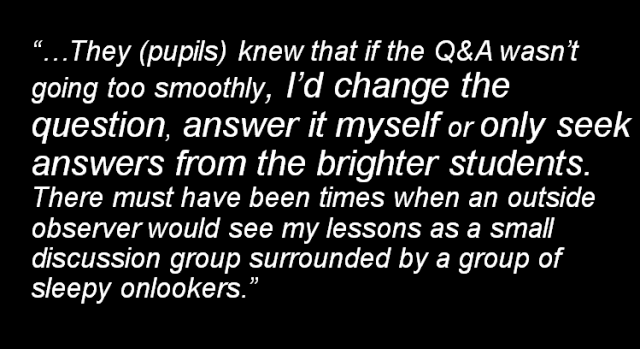
Tonight’s 15 minute forum was led by PE teacher James Crane. James started the session with a quote (source unknown) that he suggests would be familiar to most teachers – at some point in our career:
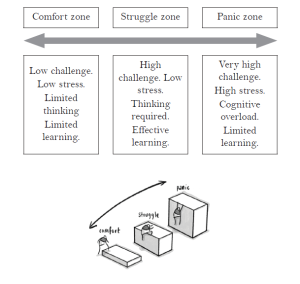
So, it’s worth thinking about the purpose of questioning:
View original post 859 more words
Posted in Uncategorized
Much has been written about organizations having the proper “Mission Statement” as a needed lighthouse guiding all actions within the enterprise. Now personal mission statements are used to define and clarify the personal purpose. So here is mine: “To learn and help others learn about the reality of life.” If it sounds too philosophical it is because I intended it to be.
This statement requires a lot of explaining, don’t you think? First of all, what do I mean by ‘reality of life’? Isn’t it this another way to say ‘purpose’? What is the point? Maybe, but I feel that finding out what is the reality for one’s life goes beyond any understanding of purpose, it may even go deeper to the idea of belonging. If everything is connected, how can I see me, my life, being part of a larger reality?
That is what I am looking to, that is what I am in the process of finding out. That is why my statement makes sense to me!
Do you have a mission statement?
Posted in Uncategorized
Source: Bright Spots – 9th October 2015
This is an excellent example on how collaboration enhances the teaching-learning experience. Just read how science teachers are addressing issues of difficulties faced by students learning science.
I highly recommend you read the full text.
Posted in Uncategorized
When teaching goes beyond the transfer of information you have to get into ‘m o d e l l i n g.’ Have a look at this great blog where Shaun Allison shares ideas and examples including Andy Tharby’s talk.
 The DHS 2015-16 15 minute forum programme was kicked off tonight, with Andy Tharby talking about modelling.
In his first year of teaching, Andy taught a top set Y11 class. He worked his socks off for a year, but come the summer, only four of them achieved a grade A. On reflection he soon realised why – he wasn’t modelling to the students, how they needed to apply their knowledge and skills. It soon became clear to Andy that modelling is teaching.
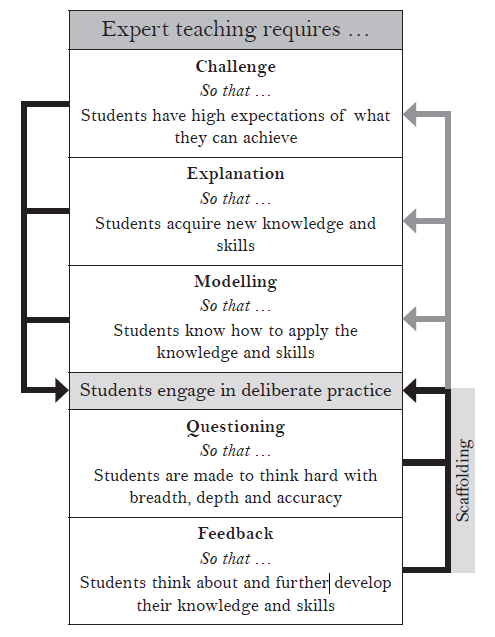
Within our six principles of great teaching, modelling is key. Why?
2. It makes abstract success criteria concrete. Simply telling students what the success criteria are, or writing them down can be relatively meaningless for students. They need to be able to see what they are aiming for.
3. It excavates the thought processes…
View original post 709 more words
Posted in Uncategorized
 | Joe Linker on He lived until he died |
 | DavidJTerrell on About 3930 Weeks (End of year… |
 | Sherry P Todd on About 3930 Weeks (End of year… |
 | Mary Ann Cutler on About 3930 Weeks (End of year… |

 David J Terrell